.jpg)

Alien Creature Design: Build Believable Species

What makes an alien feel like a living species instead of a collection of strange parts?
Strong alien creature design begins with cause and effect. Habitat shapes anatomy, anatomy shapes movement, and movement reveals behavior. When those decisions support one another, even an unfamiliar silhouette can feel immediately plausible.
This guide turns that principle into a production workflow for concept artists, creature designers, modelers, riggers, animators, VFX teams, and real-time developers. It explains how to build a species from ecology through final delivery while keeping creative ambition connected to technical reality.
Table of Contents
Start With Ecology Before Anatomy

A believable alien is not designed in a vacuum. Begin with the world it occupies: gravity, atmosphere, temperature, light, available water, terrain, predators, prey, and social competition. These pressures give every major visual choice a reason. A broad foot may distribute weight over soft ground; recessed eyes may resist windblown grit; reflective tissue may regulate heat or communicate at distance.
Write a one-page ecology brief before drawing details. Define what the creature eats, how it senses danger, when it rests, whether it migrates, how it reproduces, and what role it plays in the local food web. The brief does not need to become on-screen exposition. Its job is to keep the design team solving the same biological problem.
Scale the environment against the creature as early as possible. A doorway, plant, cliff, vehicle, or human reference reveals whether the species can navigate its world and whether the intended sense of awe survives in a shot. Environmental scale also affects sound, dust, vegetation response, footprints, and the amount of secondary animation needed to sell presence.
For a wider production context, review Mimic Creatures’ creature design and animation services, where concept, modeling, rigging, animation, and integration are treated as one connected pipeline.
Define the habitat and its strongest survival pressure.
Choose one ecological niche rather than giving the species every advantage.
Decide which features are functional, communicative, defensive, or vestigial.
Test whether the creature could feed, rest, reproduce, and move through its world.
Build Alien Anatomy From Function
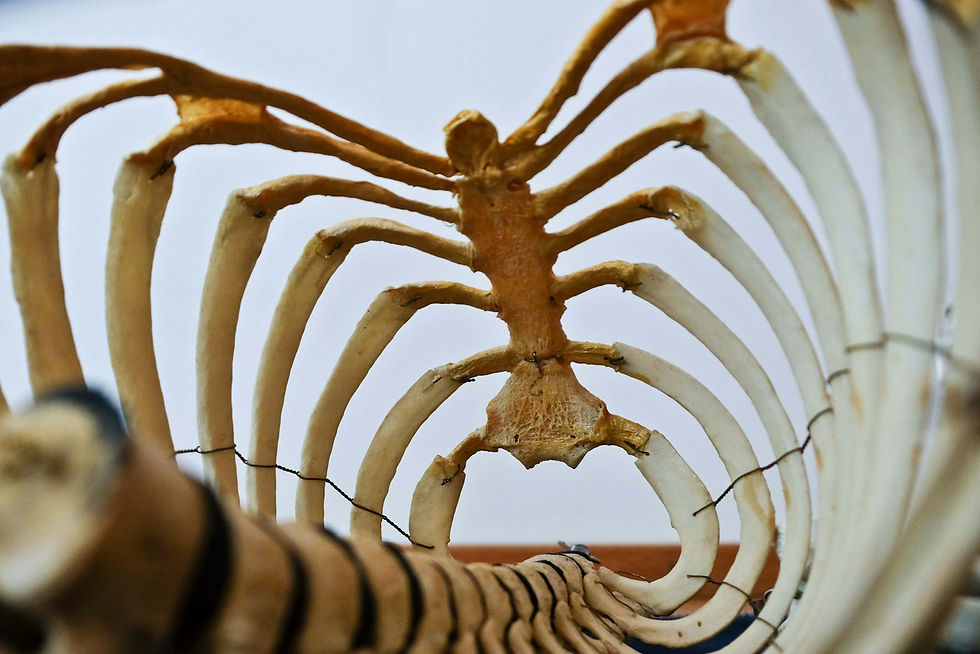
Once the ecology is clear, design the load path. Decide where the mass sits, how the skeleton transfers force, which joints absorb impact, and what muscles power the dominant action. A convincing creature does not need terrestrial anatomy, but it does need internal logic. Weight must travel through the body in a way the audience can read.
Start with large structural questions before sculpting surface detail. Is the creature bilateral, radial, or asymmetrical? Does it carry a rigid internal skeleton, an exoskeleton, hydrostatic support, or a hybrid system? How many limbs actively bear weight, and which are specialized for feeding, display, manipulation, or defense? If two structures do the same job, decide why both survived evolution.
This is where production-aware creature concept art prevents costly redesign. Clear joint landmarks, range-of-motion notes, scale references, and material callouts help modelers and riggers preserve the original idea instead of interpreting gaps independently.
Silhouette is the fastest anatomy test. Reduce the design to a dark shape and pose it in locomotion, rest, threat, and feeding states. If the body plan only reads in a presentation pose, the design is not yet robust enough for production.
Run a basic physiological audit as well. Locate the breathing system, circulation routes, sensory clusters, feeding apparatus, and vulnerable zones. You do not need to illustrate every organ, but deciding where these systems live prevents later contradictions—for example, armor that blocks expansion of the torso or a feeding mechanism that collides with the primary sensory organs.
Use Earth Analogues Without Copying

Nature is the best library of solved design problems. Insects demonstrate compound vision, distributed limbs, armor, metamorphosis, and chemical communication. Deep-sea animals show bioluminescence, pressure adaptation, transparency, and unfamiliar feeding structures. Birds reveal lightweight construction and precise control surfaces; reptiles show economical movement and protective integument.
The goal is not to paste a mantis head onto a lizard body. Study the mechanism behind a reference, then translate the principle. If compound eyes inspire the design, ask how the creature processes many visual inputs and whether its head movement changes. If an exoskeleton inspires armor, decide where plates must separate to permit deformation.
A useful companion is the guide to 3D modeling for creature anatomy, which explains why anatomical landmarks become especially important when a character lacks familiar human facial and shoulder cues.
Combine references by function, not appearance. One species might borrow a camel’s water economy, a gecko’s adhesion strategy, a cuttlefish’s signaling system, and a bird’s respiratory efficiency. The final form can look original because the borrowed ideas are integrated into a single ecology rather than displayed as separate visual quotations.
Design Locomotion, Weight, and Performance

Movement is the moment an alien design proves itself. Establish locomotion while the silhouette is still flexible. Identify the center of mass, stride pattern, balance strategy, contact points, recovery behavior, and energy cost. A heavy animal should prepare, transfer weight, and settle differently from a light ambush hunter, even when both move quickly.
Create a small movement vocabulary: neutral idle, alert idle, slow travel, fast travel, turn, stop, feed, threaten, retreat, and recover. These clips expose conflicts that a static concept hides. Extra limbs may collide, a large crest may destroy balance, or a beautiful jaw may lack room to open. Early motion tests make those problems inexpensive.
For complex species, the principles behind multi-limb creature rigging help determine control hierarchy, gait coordination, ground contact, and readable overlap. Mimic Creatures’ motion-capture approach also shows how human performance can become useful source material without forcing non-human anatomy into a human gait.
Performance matters as much as mechanics. Decide how curiosity, fear, dominance, pain, and social bonding travel through the body. A creature with no eyebrows can still communicate through breath, posture, pupil response, appendage tension, color change, or rhythm. Those choices make the species legible without making it human.
Sound and motion should be designed together. Vocal effort changes breathing and posture, footfalls reveal mass, and small material sounds can identify shells, membranes, quills, or wet tissue before the creature enters frame. Early audio sketches help animators find pauses and accents that make a performance feel intentional rather than mechanically continuous.
Make Surfaces Signal Alien Biology

Skin, scales, feathers, plates, mucus, fur, and membranes are not decoration. They tell the audience how the organism regulates temperature, protects itself, senses the environment, ages, heals, and communicates. Surface design should reinforce the ecological and anatomical choices already made.
Map material transitions to function. Flexible tissue belongs near joints and breathing zones; abrasion appears at contact points; display surfaces may be cleaner, brighter, or more reflective; protected folds may retain moisture or pigment. Variation should follow growth, wear, health, and behavior rather than being applied as uniform noise.
A dedicated creature look-development workflow helps teams validate form under the lighting, camera distance, and rendering conditions of the final medium. The Mimic Creatures technology stack connects scanning, texturing, capture, animation, and real-time tools when the target requires both close-up detail and efficient playback.
Test the surface in motion. Scales must separate without obvious texture stretching, membranes need plausible tension, and layered elements need collision rules. A still render can hide these failures; deformation and lighting reveal them immediately.
Prepare the Creature for Games, VFX, and XR

A successful alien is not only memorable; it is deliverable. Before final modeling, define the target engine or renderer, camera range, shot count, interaction level, frame-rate budget, polygon budget, texture strategy, grooming requirements, simulation needs, and handoff format. The same species may require different assets for a VFX close-up, a game encounter, and a room-scale XR experience.
Build approval gates around risk. First approve ecology and silhouette, then anatomy and motion, then surface language, then final asset quality. This prevents a team from polishing a creature whose fundamental movement or integration assumptions are still unresolved.
Use a documented creature pipeline handoff and include scale, naming, hierarchy, texture sets, material assignments, rig version, animation list, collision proxies, LODs, known limitations, and test scenes. Follow that with creature QA testing across representative lighting, cameras, platforms, and edge cases.
For interactive work, test behavior as a system. Check whether gaze, spacing, reaction timing, pathfinding, and transitions support the intended personality. For linear VFX, test continuity between shots and make sure secondary motion does not drift away from the performance. For XR, prioritize comfort, personal space, scale cues, and responsive timing.
Maintain a creature bible through delivery. Record approved proportions, color ranges, gait rules, emotional poses, forbidden deformations, material responses, and naming conventions. This reference keeps new shots, downloadable content, sequels, and marketing assets consistent even when production moves between teams or vendors.
Mimic Creatures brings these disciplines together across services, research and technology, and the wider Mimicverse network so an alien species can move from story premise to a production-ready digital creature without losing its original logic.
Alien Creature Design FAQ
What makes an alien creature design believable?
Believability comes from consistent cause and effect. Habitat, anatomy, movement, behavior, and surface materials should support one another, even when the final species looks unlike anything on Earth.
Should alien creatures follow Earth anatomy?
Not exactly. They need structural logic rather than a terrestrial template. Earth animals are useful references for solved functions such as support, sensing, flight, armor, feeding, and communication.
How do you avoid making an alien look like mixed animal parts?
Combine references by mechanism and ecological purpose. Translate how a feature works, then redesign it for one coherent habitat and body plan instead of preserving each source animal’s appearance.
When should rigging and animation begin?
Movement tests should begin during concept development. Simple rigs and blockout animation reveal balance, collision, range-of-motion, and silhouette problems before detailed modeling makes changes expensive.
How many limbs should an alien creature have?
Use as many as the ecology and behavior justify. Every limb adds modeling, rigging, animation, collision, and readability costs, so specialized roles should be clear.
Can motion capture work for non-human creatures?
Yes. Human or animal performance can provide timing, weight, intention, and emotional reference. The data must be retargeted and artistically adapted to the alien’s proportions, joints, gait, and balance strategy.
What is different about alien creatures for games versus VFX?
Games prioritize real-time performance, reusable states, LODs, collision, and responsive behavior. VFX may prioritize shot-specific detail, simulation, camera continuity, and final-frame realism.
What should an alien creature brief include?
Include habitat, ecological niche, scale, behavior, emotional role, anatomy references, target medium, camera distance, technical budget, required actions, material direction, and delivery format.
How do you test whether a creature reads clearly?
Review silhouettes in multiple poses, show short motion tests without explanation, and ask viewers to identify weight, mood, threat level, direction of travel, and primary sensory organs.
Can Mimic Creatures develop a complete alien species?
Yes. Mimic Creatures supports concept development, modeling, texturing, rigging, grooming, animation, motion capture, rendering, real-time optimization, and production integration for games, VFX, XR, and immersive experiences.
Conclusion
The most convincing alien creature designs feel discovered rather than assembled. They emerge from a habitat, solve specific survival problems, carry weight through a coherent anatomy, and communicate through movement and material. That logic gives artists room to be stranger, because the audience has a system it can believe.
Ready to turn an alien species into a production-ready digital creature? Explore Mimic Creatures and start a conversation about your game, VFX, XR, or immersive project.


Comments